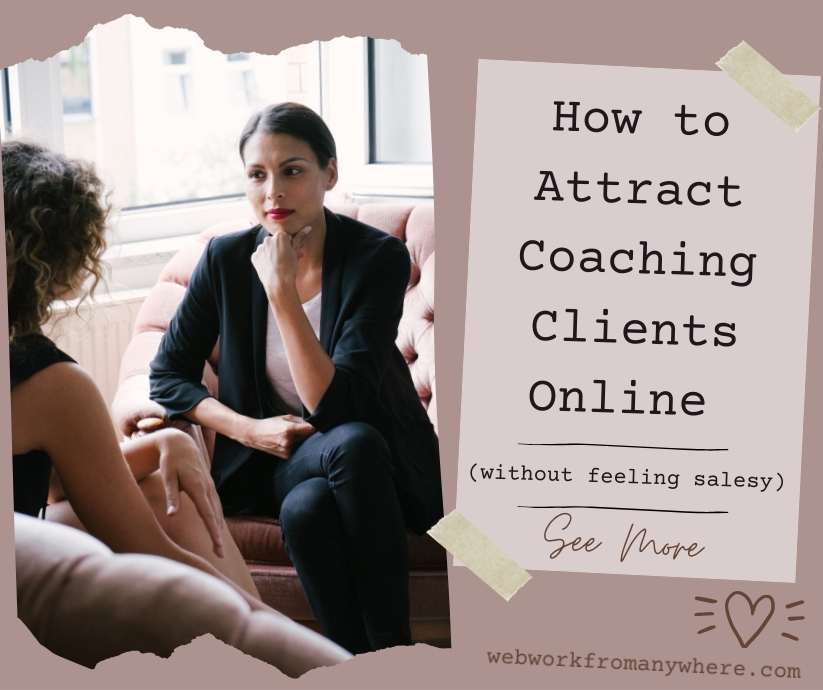
You know you can help people, but promoting yourself online feels uncomfortable – maybe even icky. The thought of “selling” makes you cringe, and you worry about coming across as pushy or desperate. If you’ve been wondering how to attract coaching clients online without aggressive marketing, here’s the truth: attracting clients doesn’t require hard selling. Authenticity and genuine connection work far better anyway…
- 1. Why Does Traditional Marketing Feel So Wrong?
- 2. How Do I Build Trust Through Content?
- 3. Which Social Media Strategies Actually Work for Coaches?
- 3. How Does Storytelling Help Me Connect With My Audience?
- 4. What About the Actual “Asking for the Sale” Part?
- 5. FAQ – How to Attract Coaching Clients Online
- Wrapping Up: Your Next Steps
Start Here > Share Your Skills > Coaching > Teach Hobbies > Email Marketing > Social Media Marketing > Resources > Reviews
1. Why Does Traditional Marketing Feel So Wrong?
If you’re over 50, you probably grew up valuing modesty and genuine relationships over self-promotion.
The pushy marketing tactics you see online – endless sales pitches, fake urgency, manipulative language – naturally feel wrong.
Here’s what changes everything: You’re not selling. You’re inviting people into a conversation about solving a problem they’re already struggling with.
When you shift from “I need to convince people” to “I’m helping people who already want what I offer find me,” everything feels different.

2. How Do I Build Trust Through Content?
Trust is your currency online. People hire coaches they trust, and trust develops when you consistently show up offering genuine help.
What Kind of Content Actually Builds Trust?
Educational content that solves small problems. Share practical tips people can use immediately. If you’re a career coach, post about updating LinkedIn profiles or answering tough interview questions.
When someone gets value from your free content, they think: “If the free stuff is this good, imagine what I’d get if I hired them.”
Vulnerable stories about your journey. Share what you’ve learned from mistakes, not just successes.
“I spent three years in a job that drained me because I was afraid to make a change. Here’s what finally gave me courage…” People see themselves in your story.
Client success stories (with permission). Nothing builds trust like proof. “Maria came to me feeling stuck in her career at 55. Six months later, she’s running her own consulting business.” Real results overcome skepticism.
Take Action
- Start with 3-4 posts weekly on one platform.
- Consistency matters more than frequency.
- Batch your content creation – spend two hours every Sunday writing the week’s posts.
- Use Canva (free version) to create simple graphics. The templates are designed for non-designers.
Every client question becomes content. Every challenge you’ve overcome becomes content. Keep a running list on your phone and you’ll never run out of ideas.
See More: 15 Essential Resources for Life Coaches and 7 Best Online Coaching Platforms
3. Which Social Media Strategies Actually Work for Coaches?
Pick ONE platform to start. Master it before adding others.
LinkedIn for professional coaching – careers, leadership, business challenges. Your ideal clients are already there.
Facebook for life coaching and personal development. Particularly strong for connecting with people over 50. Join relevant groups and participate genuinely.
Instagram for wellness, creativity, and lifestyle coaching. Visual platform where inspirational content performs well.
a) What Should My Profile Actually Say?
Your headline matters enormously.
- Weak: “Life Coach | Helping People”
- Strong: “I help burnt-out professionals over 50 rediscover purpose and create meaningful second careers”
Specific beats generic every time. Your bio should answer: Who do you help? What problem do you solve? What makes you different?
b) How Do I Engage Without Being Annoying?
Spend 15-20 minutes daily genuinely engaging:
- Comment thoughtfully on 5-10 posts in your niche
- Respond to every comment on your content within 24 hours
- Send 2-3 direct messages to connect (not pitch)
- Join conversations in groups where your ideal clients gather
Tool recommendation: Buffer or Tailwind let you schedule posts in advance. Free plans work perfectly for beginners.
Read More:
- Is ManyChat Legit and Safe to Use?
- How Buffer Keeps Your Social Media Active
- Pinterest Design Tips for Beginners Over 50

3. How Does Storytelling Help Me Connect With My Audience?
Stories bypass skepticism and connect emotionally. The right story feels nothing like selling.
a) What Stories Should I Tell?
Your origin story. Why did you become a coach?
For example: “At 52, I found myself divorced, starting over, and terrified. I rebuilt my life from scratch and discovered strengths I never knew I had. Now I help other women navigate major life transitions with confidence.”
Transformation stories. Show the journey from problem to solution:
Before: “Sarah felt invisible at work. Passed over for promotions despite her experience, she was considering early retirement even though she couldn’t afford it.”
After: “Six months later, Sarah negotiated a leadership role, a 30% salary increase, and feels energized about work for the first time in years.”
Vulnerable moments. Share times you struggled or made mistakes. This makes you relatable and human.
b) How Do I Tell Stories Without Sounding Generic?
Use specific details. Not “I was unhappy at my job” but “I sat in that gray cubicle every morning, staring at spreadsheets, wondering if this was all there was.”
Show the messy middle. Don’t skip from problem to solution. Show the struggle, the setbacks, the moments you almost quit. That’s where connection happens.

4. What About the Actual “Asking for the Sale” Part?
a) How Do I Mention My Services Without Being Pushy?
The soft mention: At the end of a helpful post, add: “This is the kind of breakthrough we create together in my coaching program. If you’d like to explore working together, here’s how to book a free call.”
The story close: After sharing a client success story: “If you’re experiencing something similar and want support, I have two spots opening next month. Message me if you’d like to chat.”
The value-first approach: Offer something free first (worksheet, guide, webinar), then follow up with people who engage. They’ve already shown interest.
Tool recommendation: Mailerlite (free up to 500 subscribers) makes email list building simple.
Create a free resource, collect emails, send weekly helpful content, and occasionally mention your coaching.
People who’ve been reading your emails for weeks feel like they already know you.
b) What If Someone Says No?
Perfect. Not everyone is ready, not everyone is a fit. A “no” today might be a “yes” in six months.
Stay connected, keep providing value, and let them come back when timing is right.

5. FAQ – How to Attract Coaching Clients Online
a) How long until I see results from content marketing?
Most coaches see their first inquiries within 2-3 months of consistent posting. Your first paying clients typically come within 3-6 months.
b) Do I need to be on video?
Not necessarily. Written content works beautifully if you’re uncomfortable on camera. Video creates stronger connection, but your audience wants authentic you, not professional production.
c) Should I post the same content on multiple platforms?
Yes. Repurpose relentlessly. Turn one blog post into three social posts, a video, and an email. Most of your audience sees only 5-10% of what you post anyway.
d) How do I balance giving away free value without giving away everything?
Share the “what” and “why” freely. Save the “how” for paying clients.
Freely share that mindset work is crucial for career transitions (what) and why it matters. But the specific frameworks and personalized guidance (how) happen in coaching.
Wrapping Up: Your Next Steps
Start today by choosing one platform, writing three helpful posts based on questions your ideal clients ask, and scheduling them for this week. Building an audience takes time, but every post moves you closer to clients who find you naturally. Begin with consistent action, not perfection.
Next read: The Pros and Cons of Starting an Online Coaching Business – is this right for you?